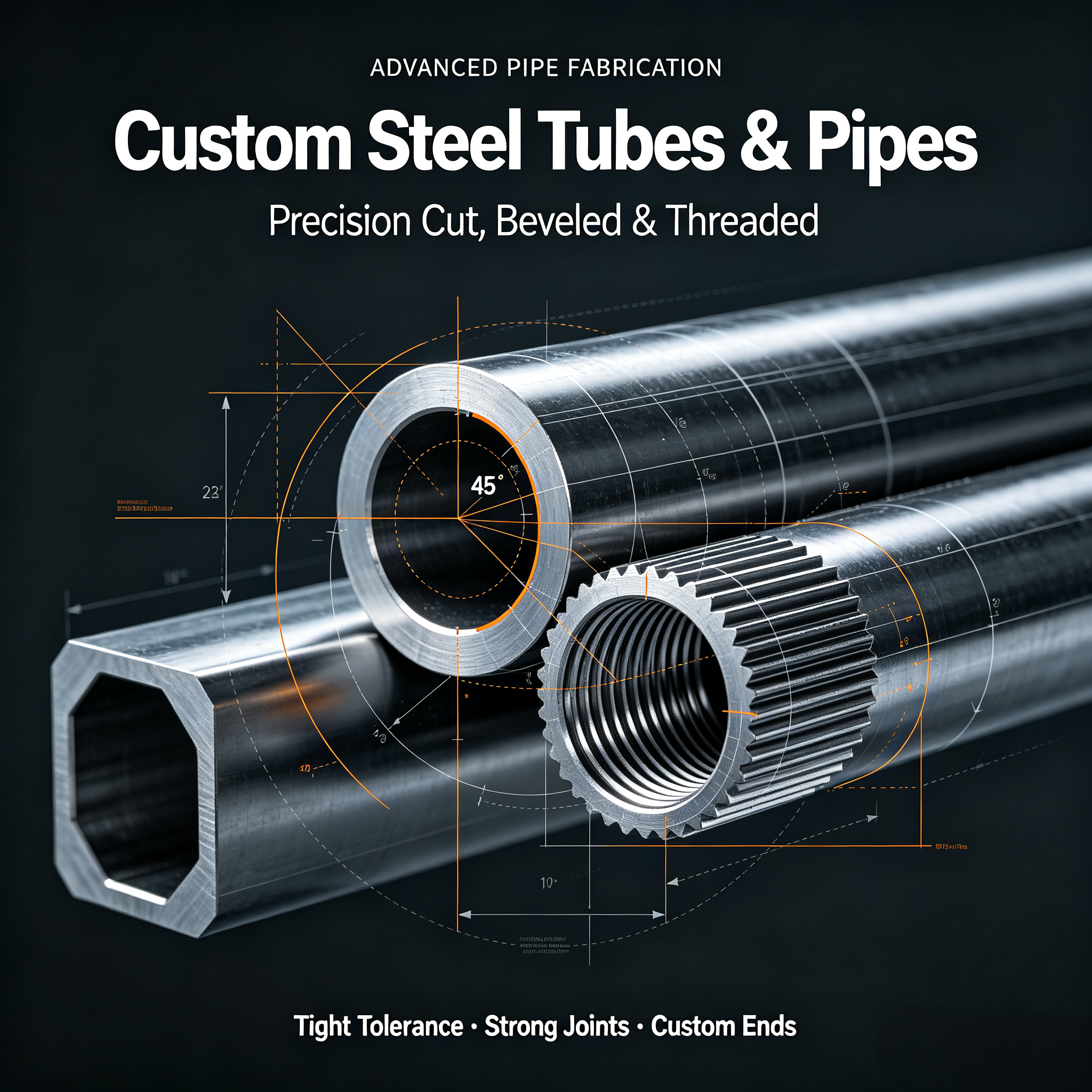
Custom Steel Tubes & Pipes – Precision Cut, Beveled & Threaded
Introduction
In industrial manufacturing, a steel tube is rarely installed exactly as it leaves the mill.
Whether the final application is a structural frame, a pressure piping system, a conveyor line, or heavy equipment, most Steel Tubes & Pipes require additional processing before they reach the job site. Precision cutting, beveling, threading, drilling, and end finishing are no longer considered optional value-added services—they are part of modern manufacturing.
I've spoken with procurement engineers who initially focused only on material grade and price. A few weeks later, however, production delays appeared because tubes arrived with inconsistent lengths, poorly finished ends, or thread dimensions that didn't match the required fittings. The material itself wasn't the problem. The processing quality was.
That distinction is becoming increasingly important.
Today's manufacturers are expected to deliver components that fit directly into automated fabrication and assembly lines with minimal rework. Every millimeter matters. Every bevel angle affects weld quality. Every thread influences sealing performance.
This is why custom steel tubes & pipes have become an essential part of industrial supply chains rather than a simple commodity purchase.
In this article, we'll explore how precision processing improves manufacturing efficiency, why machining quality deserves as much attention as material specifications, and what buyers should evaluate before selecting a steel tube processing partner.
Table of Contents
Why Custom Steel Tubes & Pipes Are Becoming the Industry Standard
Understanding Precision Processing Beyond Material Supply
Precision Cutting, Beveling and Threading Explained
Why Precision Matters More Than Most Buyers Realize
Processing Quality Begins with Material Selection
Quality Standards That Influence Processing Performance
Where Custom Steel Tubes & Pipes Create the Greatest Manufacturing Advantage
From Drawing to Finished Component: The Processing Workflow
Why Processing Consistency Reduces Total Project Cost
Real Industry Example
Questions Procurement Teams Should Ask Before Choosing a Supplier
Frequently Asked Questions
Conclusion
References
1. Why Custom Steel Tubes & Pipes Are Becoming the Industry Standard
There was a time when purchasing steel tubing was relatively straightforward.
Select the material grade. Choose the diameter and wall thickness. Order the required quantity.
Today, manufacturing has become considerably more integrated.
Fabrication workshops increasingly rely on CNC cutting equipment, robotic welding systems, automated assembly lines, and digital production scheduling. These processes demand greater dimensional consistency than ever before.
As a result, Steel Tubes & Pipes are now expected to arrive production-ready rather than requiring significant preparation after delivery.
For many manufacturers, precision processing delivers several practical advantages:
Less manual cutting on site
Reduced welding preparation time
Better dimensional consistency
Faster assembly
Lower material waste
Improved production scheduling
From an operational perspective, this approach also reduces variability.
When every processed tube arrives with identical dimensions and properly finished ends, downstream fabrication becomes far more predictable.
Consistency—not simply speed—is often what separates efficient production from repeated rework.
2. Understanding Precision Processing Beyond Material Supply
One misconception still appears in some procurement discussions.
Steel tube processing is sometimes viewed as a secondary service added after production.
In reality, it has become an integrated manufacturing process.
Modern steel tube fabrication combines material processing with digital manufacturing technologies to ensure components meet strict engineering requirements before reaching the customer.
Typical processing capabilities include:
Precision Cutting
Automatic saws, laser cutting systems, and CNC tube cutting equipment produce consistent lengths while minimizing burr formation.
Accurate cutting reduces assembly adjustments and helps maintain dimensional tolerances throughout the fabrication process.
End Beveling
Beveled pipe ends prepare components for welding.
Proper bevel geometry improves weld penetration, reduces joint preparation time, and contributes to stronger welded connections, particularly in pressure piping and structural applications.
Thread Processing
Threaded pipe ends allow mechanical connections without welding.
Thread accuracy directly influences sealing performance, assembly efficiency, and compatibility with standardized fittings.
Hole Drilling and Slotting
Many custom tube applications require additional machining for mounting brackets, mechanical fasteners, or integrated assemblies.
Completing these operations before delivery helps eliminate secondary machining during production.
Rather than treating these processes independently, experienced manufacturers integrate them into a controlled workflow where dimensional inspection follows each critical operation.
3. Precision Cutting, Beveling and Threading Explained
Precision Cutting
Precision cutting is the foundation for all subsequent operations. Whether straight cuts, angled cuts, or complex profiles, cut quality directly affects the efficiency of downstream processes and final product quality.
Common Processes:
CNC Band Saw Cutting: Suitable for high-volume, medium-precision cutting.
Laser Tube Cutting: Delivers exceptional accuracy and clean edges, ideal for thin-wall tubes and complex shapes.
Plasma Cutting: Used for high-speed cutting of thick-wall tubes.
Key Metrics:
Length tolerance (e.g., ±0.5mm)
Cut perpendicularity
Burr height
End Beveling
Beveling is a critical step in weld preparation. Correct bevel geometry (such as V-type, U-type, or J-type) ensures complete weld penetration and reduces weld defects.
Common Processes:
Mechanical Beveling: Cold working using beveling machines, providing consistent angles and surface finish.
Thermal Beveling: Simultaneous cutting and beveling using flame or plasma, offering high speed.
Key Metrics:
Bevel angle (e.g., 30°, 37.5°)
Land thickness
Bevel surface roughness
Thread Processing
Threaded connections are one of the most common mechanical joining methods in piping systems. Accurate threads are essential for connection strength and sealing performance.
Common Processes:
Thread Rolling: Formed by extrusion, producing high-strength threads with smooth surfaces.
Thread Cutting: Formed by machining, offering high precision and suitability for various materials.
Key Metrics:
Thread type (NPT, BSP, Metric, etc.)
Thread length
Go/No-go gauge inspection
4. Why Precision Matters More Than Most Buyers Realize
From a technical perspective, a deviation of one or two millimeters may appear insignificant.
On an individual tube, it often is.
Across hundreds—or thousands—of fabricated assemblies, those small deviations accumulate surprisingly quickly.
Poorly controlled dimensions may lead to:
Misaligned welded joints
Increased fitting adjustments
Longer installation times
Additional material waste
Reduced assembly consistency
This becomes particularly important in industries using automated welding systems.
Industrial robots operate according to programmed coordinates.
If component dimensions vary beyond acceptable tolerances, welding quality may decline or production speed must be reduced to compensate.
For manufacturers pursuing lean production principles, dimensional consistency supports not only product quality but also operational efficiency.
5. Processing Quality Begins with Material Selection
Even the most advanced machining equipment cannot compensate for unsuitable raw material.
Selecting the correct material remains the first engineering decision.
Depending on the application, manufacturers commonly process:
Material Type | Typical Applications | Key Characteristics |
Carbon Steel Tubes | Structural fabrication, machinery, pipelines | High strength and cost efficiency |
Stainless Steel Pipes | Food processing, pharmaceuticals, chemical plants | Corrosion resistance and hygienic performance |
Alloy Steel Tubes | Energy, mining and heavy industry | Enhanced mechanical properties |
Mechanical Steel Tubes | Automotive and industrial equipment | Tight dimensional tolerances and machinability |
Material selection should always consider:
l Operating pressure
l Corrosion environment
l Mechanical loading
l Welding requirements
l Applicable industry standards
l Expected service life
Choosing the correct steel grade early in the project often reduces downstream manufacturing challenges.
6. Quality Standards That Influence Processing Performance
For experienced procurement teams, compliance extends beyond material certification.
Processing quality should also follow recognized international standards whenever applicable.
Depending on the project, buyers commonly request compliance with standards published by:
ASTM International
ASME Boiler and Pressure Vessel Code
ISO quality management systems
EN standards for steel products
API specifications for energy applications
While the exact standard varies by industry, certified manufacturing processes generally provide greater confidence in dimensional accuracy, traceability, and inspection consistency.
Documentation such as material test certificates (MTCs), dimensional inspection reports, and weld preparation records can also simplify quality verification during project acceptance.
7. Where Custom Steel Tubes & Pipes Create the Greatest Manufacturing Advantage
Although almost every industrial sector uses Steel Tubes & Pipes, the processing requirements vary considerably from one application to another. What remains consistent, however, is the need for dimensional accuracy and repeatability.
Take structural fabrication as an example.
Steel tubes used in modular buildings, warehouse racking, lifting equipment, or heavy machinery are rarely assembled by a single technician making manual adjustments. Increasingly, these components move through CNC fabrication cells, robotic welding stations, and automated assembly lines. When every tube arrives with the correct length, bevel angle, and hole position, production flows much more smoothly.
The same principle applies in process industries.
For pressure piping systems, properly machined pipe ends contribute to more consistent weld preparation, while precision-threaded connections help ensure compatibility with standardized fittings. Neither operation is particularly visible after installation, but both influence assembly efficiency and long-term system reliability.
This is why many manufacturers no longer purchase raw tubing alone—they purchase processed steel tube solutions that are ready for fabrication.
Typical industries benefiting from custom processing include:
Construction and structural engineering
Oil and gas
Water and wastewater treatment
Mechanical engineering
Agricultural machinery
Automotive manufacturing
Renewable energy
Material handling equipment
8. From Drawing to Finished Component: The Processing Workflow
A well-managed steel tube processing project typically begins long before the first cut is made.
Experienced suppliers usually follow a structured workflow:
Engineering Review
Customer drawings are reviewed to confirm dimensions, tolerances, material grades, end preparations, and any secondary machining requirements.
Minor design issues identified at this stage can prevent expensive production delays later.
Material Verification
Before processing begins, raw materials are verified against the required specifications.
Depending on the project, this may include:
l Material Test Certificates (MTCs)
l Heat number traceability
l Grade verification
l Dimensional inspection
Material verification establishes confidence that the finished component will meet project requirements before machining resources are committed.
Precision Processing
The production sequence may include:
l CNC tube cutting
l Laser tube processing
l End beveling
l Thread machining
l Drilling
l Slotting
l Deburring
l Surface finishing
Rather than treating these as separate services, modern manufacturers increasingly integrate them into one controlled production workflow.
Final Inspection
Before shipment, dimensional verification helps ensure processed tubes conform to engineering drawings.
Inspection commonly includes:
l Length measurement
l Outside diameter verification
l Wall thickness confirmation
l Thread inspection
l Bevel angle inspection
l Surface quality evaluation
Although these checks add time to production, they often save significantly more time during customer assembly.
9. Why Processing Consistency Reduces Total Project Cost
It's tempting to compare suppliers based only on the price per meter of tubing.
In reality, the total project cost is influenced by many additional factors.
Consider two shipments of identical carbon steel tubes.
One arrives with highly consistent dimensions, clean machined ends, and accurate threading.
The other requires additional cutting, thread repair, grinding, and repeated fitting adjustments before fabrication can begin.
Even if the second shipment costs less initially, the total manufacturing cost may increase because of:
Additional labor
Longer assembly time
Production interruptions
Material waste
Delayed project schedules
From a procurement perspective, consistency often creates greater long-term value than the lowest purchase price.
10. Real Industry Example
One practical example can be seen in the global construction and energy sectors, where Tenaris supplies processed steel tubular products for demanding infrastructure and industrial projects.
Rather than delivering only standard mill-length pipes, Tenaris also provides a range of value-added processing services—including precision cutting, threading, end finishing, inspection, and logistics support—to help customers reduce fabrication work before installation.
This approach illustrates an important industry trend.
Large engineering projects increasingly expect suppliers to provide finished or semi-finished components instead of raw materials. The objective is not simply to shorten production time, but to improve quality consistency across complex supply chains where multiple contractors and fabrication teams are involved.
11. Questions Procurement Teams Should Ask Before Choosing a Supplier
Selecting a processing partner involves much more than reviewing a product catalog.
Several practical questions can reveal whether a supplier is capable of supporting long-term production requirements.
Can dimensional tolerances be maintained consistently?
Consistency is particularly important for automated fabrication and robotic welding.
Ask how dimensional inspections are performed and documented.
What machining capabilities are available in-house?
Suppliers with integrated processing equipment can often reduce lead times by avoiding external subcontracting.
Are inspection records provided?
Inspection reports, material certificates, and traceability documentation simplify project quality control and customer acceptance.
Can small prototype orders and high-volume production both be supported?
Many manufacturers begin with prototypes before moving into serial production.
A supplier capable of supporting both phases offers greater flexibility as projects develop.
How are finished components protected during transportation?
Precision-machined threads and beveled ends can be damaged if packaging is inadequate.
Proper end protection, corrosion prevention, and secure packaging help preserve product quality throughout shipping.
12. Frequently Asked Questions
What is the difference between steel tubes and steel pipes?
Although the terms are often used interchangeably, steel tubes are generally specified by outside diameter and wall thickness with tighter dimensional tolerances, while steel pipes are commonly specified by nominal pipe size (NPS) and are primarily intended for fluid transportation.
Why is beveling important before welding?
A properly machined bevel allows better weld penetration and creates space for filler material, helping achieve stronger and more reliable welded joints.
When are threaded steel pipes preferred?
Threaded connections are commonly used where disassembly, maintenance, or mechanical assembly is required, particularly in low- and medium-pressure piping systems.
Which industries commonly require custom steel tube processing?
Typical applications include construction, oil and gas, water treatment, mechanical engineering, agricultural machinery, automotive manufacturing, renewable energy, and material handling equipment.
How can buyers verify processing quality?
Request documentation such as Material Test Certificates (MTCs), dimensional inspection reports, quality management certifications, traceability records, and surface inspection documentation. These records provide additional confidence that finished components meet engineering specifications.
13. Conclusion
Choosing Steel Tubes & Pipes is no longer only about selecting the correct material grade.
For today's manufacturers, the real value often lies in how accurately those materials are processed before they arrive at the production facility.
Precision cutting minimizes assembly adjustments. Accurate beveling improves weld preparation. Reliable threading supports secure mechanical connections. Consistent dimensional control helps automated fabrication systems operate with fewer interruptions.
When these capabilities are combined within a controlled manufacturing process, custom steel tubes become more than standard industrial products—they become production-ready components that support higher efficiency throughout the entire project lifecycle.
For procurement managers, engineers, and project owners, evaluating machining capability, quality assurance, inspection procedures, and supplier experience alongside material specifications is increasingly the best way to reduce manufacturing risk and improve long-term operational performance.