Custom Metal Stamping Parts for Automotive and Industrial Applications
Introduction: Why Custom Metal Stamping Parts Matter in Modern Manufacturing
In today’s automotive and industrial manufacturing sectors, small metal components often carry much more responsibility than their size suggests.
A bracket inside an electric vehicle battery system, a precision connector used in industrial equipment, or a structural reinforcement part in an automotive body assembly may look simple. However, these components directly affect safety, reliability, assembly efficiency, and long-term product performance.
This is why Custom Metal Stamping Parts have become a critical manufacturing solution for companies that require high-volume production, consistent quality, and precise engineering control.
From my experience working with manufacturing projects, one thing is quite clear: buyers are usually not only looking for a supplier who can “stamp metal.” They need a partner who understands material behavior, tooling design, production stability, quality requirements, and cost control.
A successful stamping project is not created by the press machine alone. It starts much earlier — with part design, engineering communication, mold development, and process planning.
This guide explains how Custom Metal Stamping Parts for Automotive and Industrial Applications are manufactured, where they are used, what engineers should consider before production, and how companies can select the right stamping solution for their projects.
Table of Contents
1. What Are Custom Metal Stamping Parts?
2. How the Custom Metal Stamping Process Works
3. Why Automotive and Industrial Manufacturers Choose Metal Stamping
4. Key Technologies Behind Precision Metal Stamping Components
5. Materials Commonly Used for Custom Stamping Parts
6. Applications in Automotive and Industrial Fields
7. Design Considerations for Engineers and Purchasing Teams
8. Quality Standards and Manufacturing Control
9. Industry Case Study
10. Frequently Asked Questions
11. Conclusion
What Are Custom Metal Stamping Parts?
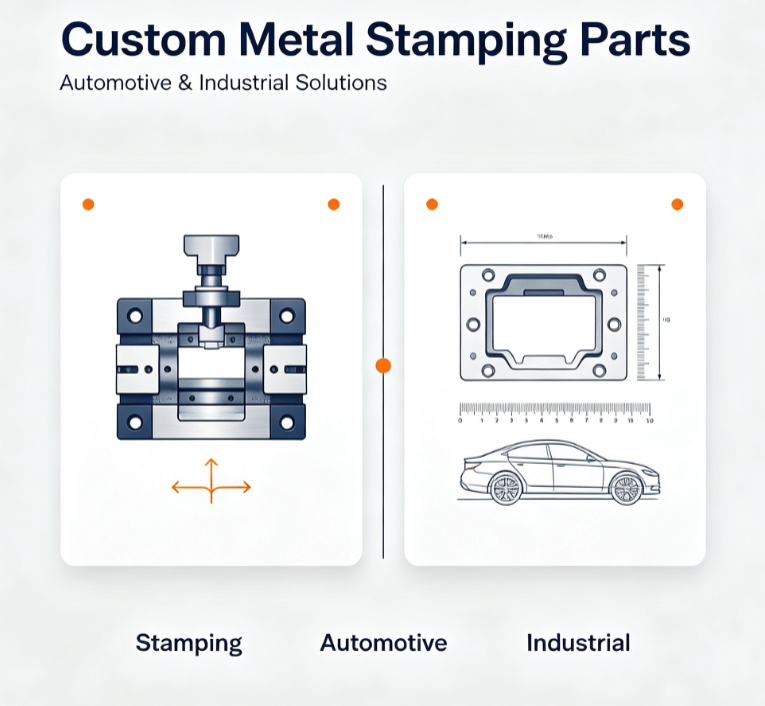
Custom Metal Stamping Parts are specially designed metal components produced through a stamping process where sheet metal or metal coils are shaped, cut, bent, or formed using specialized dies and high-pressure stamping equipment.
Unlike standard off-the-shelf components, custom stamped parts are developed according to a customer’s specific requirements, including:
· Product dimensions
· Material specifications
· Mechanical performance
· Surface requirements
· Assembly requirements
· Production quantity
· Industry standards
The stamping process is widely used because it allows manufacturers to produce large quantities of identical parts with excellent repeatability.
For example, an automotive manufacturer may require millions of identical brackets, clips, reinforcement plates, or electrical terminals every year. Manufacturing these parts individually through machining would normally create much higher costs and longer production times.
Metal stamping solves this challenge by combining:
· High production efficiency
· Consistent dimensional accuracy
· Lower unit cost in mass production
· Reduced material waste
· Stable manufacturing repeatability
According to manufacturing industry practices, stamping is especially suitable for medium and high-volume production where tooling investment can be distributed across thousands or millions of parts.
How the Custom Metal Stamping Process Works
The production of Custom Sheet Metal Stamping Services usually involves several important stages. Many buyers focus only on the final stamping operation, but in reality, every step influences the final quality.
1. Engineering Design and DFM Analysis
The first stage begins with product drawings, 3D models, and engineering requirements.
Professional stamping manufacturers usually perform Design for Manufacturing (DFM) analysis before tooling begins.
The purpose is to evaluate:
· Material flow during forming
· Bend radius requirements
· Potential cracking areas
· Tool accessibility
· Production efficiency
· Cost optimization
A small design adjustment at this stage can significantly reduce tooling problems later.
For example, increasing a bend radius slightly may prevent material cracking and improve tool life.
This is one of the areas where experienced manufacturers create real value.
2. Tool and Die Development
The stamping die is the heart of the manufacturing process.
A stamping die is a precision tool consisting of multiple components that control how metal is cut and formed.
Common die types include:
Die Type | Main Function | Typical Applications |
Progressive Die | Multiple operations in one continuous process | Automotive brackets, terminals, clips |
Compound Die | Performs multiple cutting operations simultaneously | Flat precision components |
Deep Drawing Die | Creates deep-shaped parts | Housings, containers, shells |
Forming Die | Bends and shapes metal | Structural components |
For high-volume automotive stamping parts manufacturing, progressive dies are widely used because they allow multiple operations to happen during one production cycle.
A well-designed die improves:
· Production speed
· Part consistency
· Material utilization
· Maintenance efficiency
3. Stamping Production
During production, metal sheets or coils are fed into stamping presses.
The machine applies controlled force to shape the material according to the die design.
Common stamping operations include:
Cutting
Removing unnecessary material from the sheet.
Examples:
· Holes
· Slots
· Profiles
· Openings
Bending
Creating specific angles or shapes without removing material.
Examples:
· Mounting brackets
· Supports
· Frames
Drawing
Stretching flat metal into three-dimensional forms.
Examples:
· Automotive housings
· Electrical covers
Forming
Changing the shape while maintaining material thickness.
Examples:
· Reinforcement structures
· Complex industrial components
Why Automotive and Industrial Manufacturers Choose Metal Stamping
The demand for High Precision Metal Stamping Parts continues to increase because modern industries require components that combine strength, lightweight design, and manufacturing efficiency.
Automotive Industry Requirements
Automotive manufacturers face several major challenges:
· Reducing vehicle weight
· Improving safety performance
· Supporting electric vehicle development
· Increasing production efficiency
Metal stamping plays an important role because stamped components provide excellent strength-to-weight performance.
Typical automotive applications include:
· Body brackets
· Seat frames
· Chassis components
· Battery enclosure parts
· Electrical connectors
· Door reinforcement parts
· Engine mounting components
For automotive suppliers, quality systems are especially important. Many companies supplying production vehicle programs must follow automotive-specific quality management requirements such as IATF 16949, which focuses on defect prevention, process control, and continuous improvement across the automotive supply chain.
Industrial Manufacturing Requirements
Beyond automotive applications, industrial sectors also rely heavily on custom stamped components.
Industries using metal stamping include:
· Industrial machinery
· Electrical equipment
· Telecommunications
· Appliances
· Construction equipment
· Renewable energy systems
Industrial buyers often require:
· Long service life
· Stable supply capability
· Customized dimensions
· Corrosion resistance
· Reliable assembly performance
A stamped component may not be the most visible part of industrial equipment, but failure of a small component can interrupt an entire production system.
Key Advantages of Custom Metal Stamping Parts
Performance Factor | Benefit for Manufacturers |
High-volume capability | Suitable for thousands or millions of parts |
Repeatable accuracy | Maintains consistent dimensions |
Fast production speed | Improves manufacturing efficiency |
Material efficiency | Reduces unnecessary waste |
Design flexibility | Supports complex component shapes |
Lower long-term cost | Reduces cost per part at scale |
However, stamping is not automatically the right choice for every project.
For low-volume production or extremely complex geometries, other processes such as CNC machining or additive manufacturing may sometimes be more practical.
The correct decision depends on:
· Annual production quantity
· Material requirements
· Part complexity
· Accuracy requirements
· Target cost
Materials Used for Custom Metal Stamping Parts
Material selection is one of the most important decisions in any Custom Metal Stamping Parts project.
A stamping design may look perfect on paper, but if the selected material does not match the application requirements, problems can appear during production or later during product operation.
Engineers usually consider several factors:
· Mechanical strength
· Formability
· Corrosion resistance
· Electrical conductivity
· Operating temperature
· Weight requirements
· Total production cost
Different industries have different priorities. Automotive manufacturers may focus heavily on strength-to-weight ratio, while electrical equipment manufacturers may prioritize conductivity and corrosion resistance.
The most common materials used for Precision Metal Stamping Components include:
Material | Main Characteristics | Common Applications |
Carbon Steel | High strength, economical, widely available | Brackets, supports, structural parts |
Stainless Steel | Excellent corrosion resistance and durability | Medical equipment, electrical parts, outdoor components |
Aluminum | Lightweight with good corrosion resistance | Automotive lightweight parts, housings, battery components |
Copper | Excellent electrical conductivity | Terminals, connectors, electrical contacts |
Brass | Good machinability and conductivity | Electronic components, fittings |
High Strength Low Alloy (HSLA) Steel | High strength with reduced weight | Automotive structural parts |
Material Selection for Automotive Stamping Applications
The automotive industry has increasingly moved toward lightweight materials due to fuel efficiency requirements and the rapid growth of electric vehicles.
According to research from the International Energy Agency (IEA), electric vehicle adoption has continued to expand globally, increasing demand for lightweight structures and efficient manufacturing technologies. Lightweight materials such as aluminum and advanced high-strength steels (AHSS) are becoming increasingly important in vehicle design.
Source: International Energy Agency (IEA), Global EV Outlook reports.
For automotive stamping suppliers, this creates new challenges.
High-strength materials improve vehicle safety, but they are also more difficult to form.
They require:
· Higher stamping force
· More advanced die design
· Better simulation analysis
· Improved tool materials
This is why experienced OEM Metal Stamping Manufacturers invest heavily in engineering capability rather than simply increasing machine capacity.
Advanced Technologies Behind Precision Metal Stamping Components
Modern metal stamping is no longer just a mechanical forming process.
Today’s manufacturers combine traditional stamping equipment with digital engineering, automation, and inspection technologies.
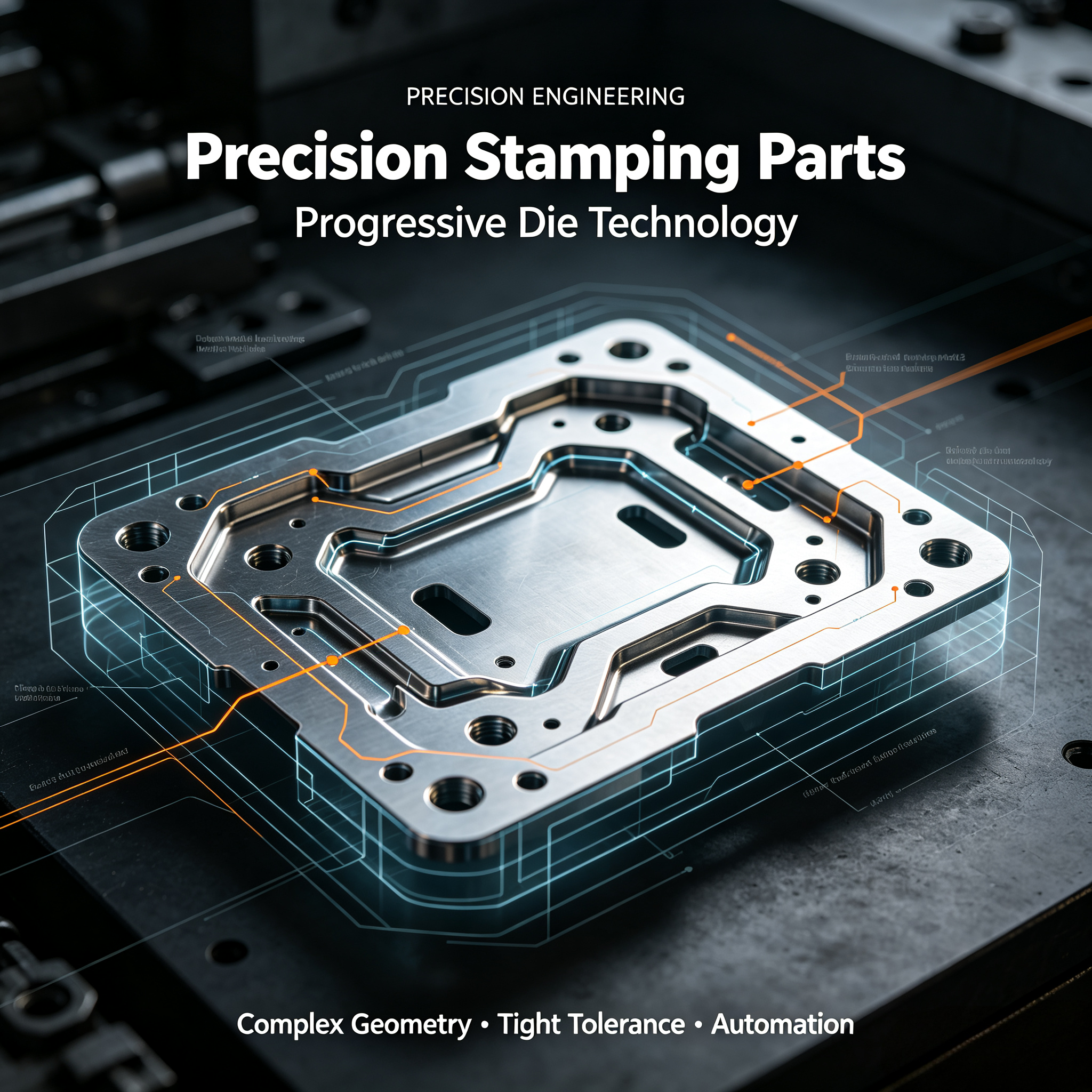
1. Progressive Die Stamping
Progressive stamping is one of the most widely used methods for large-volume production.
In this process, a metal strip moves through multiple stations inside a single die.
Each station performs a specific operation:
· Punching
· Bending
· Forming
· Cutting
· Final separation
The major advantage is speed.
A single progressive die can produce thousands of components per hour depending on part complexity and machine capability.
This makes it especially suitable for:
· Automotive clips
· Electrical terminals
· Precision brackets
· Small structural components
2. Deep Drawing Technology
Deep drawing transforms flat metal sheets into three-dimensional shapes.
The process stretches the material into a cavity without cutting it away.
Common applications include:
· Battery covers
· Motor housings
· Electronic enclosures
· Industrial containers
Successful deep drawing depends heavily on:
· Material ductility
· Lubrication control
· Tool design
· Press capability
Incorrect parameters may lead to defects such as:
· Wrinkles
· Cracks
· Uneven thickness
3. Laser Cutting and Hybrid Manufacturing
Many modern Custom Sheet Metal Stamping Services combine stamping with other technologies.
For example:
· Laser cutting for prototype development
· CNC machining for secondary operations
· Welding for assemblies
· Surface treatment after stamping
This hybrid approach allows manufacturers to support both prototype projects and large-scale production.
4. Simulation and Digital Manufacturing
Computer simulation has become an important part of modern stamping development.
Before creating expensive tooling, engineers can analyze:
· Material deformation
· Stress distribution
· Potential forming failures
· Springback behavior
This reduces trial-and-error during tooling development.
For automotive projects where tooling costs can be significant, simulation helps shorten development cycles and reduce unnecessary expenses.
Automotive Applications of Custom Metal Stamping Parts
Automotive manufacturing is one of the largest application areas for stamped components.
A modern vehicle contains hundreds or even thousands of stamped metal components.
These parts are used in both visible and hidden areas.
Body and Structural Components
Examples include:
· Door reinforcement beams
· Cross members
· Seat brackets
· Roof supports
· Chassis reinforcement parts
These components require:
· High strength
· Accurate dimensions
· Reliable welding performance
Even small dimensional variations can affect vehicle assembly.
Electrical and Battery System Components
The growth of electric vehicles has created new demand for specialized stamping components.
Applications include:
· Battery tray components
· Electrical connectors
· Busbar supports
· Shielding covers
· Mounting brackets
Battery-related components require particularly strict quality control because they influence safety and system reliability.
Interior and Functional Components
Stamped parts are also widely used in:
· Seat mechanisms
· Dashboard structures
· HVAC components
· Locking systems
· Window mechanisms
These components usually require a balance between strength, weight, and production efficiency.
Industrial Applications of Custom Metal Stamping Parts
Outside automotive manufacturing, industrial sectors depend heavily on customized stamping solutions.
Electrical and Electronics Industry
Metal stamping is commonly used for:
· Connector terminals
· Contact springs
· Shielding components
· Mounting brackets
Copper and brass stamping parts are especially common because of their excellent electrical properties.
Industrial Machinery
Heavy equipment manufacturers use stamped components for:
· Protective covers
· Structural supports
· Mounting plates
· Mechanical brackets
In industrial environments, durability and repeatability are often more important than appearance.
Renewable Energy Equipment
Solar, wind, and energy storage industries increasingly require customized metal components.
Examples include:
· Mounting brackets
· Frame connectors
· Structural supports
· Electrical components
These applications often require corrosion-resistant materials because equipment operates outdoors for many years.
Quality Control in Custom Metal Stamping Manufacturing
For professional buyers, production capability alone is not enough.
Quality consistency is usually the deciding factor when selecting a stamping supplier.
A reliable manufacturer should have a structured quality management system covering the entire process.
Incoming Material Inspection
Before production begins, raw materials are checked for:
· Material grade
· Thickness
· Surface condition
· Mechanical properties
Incorrect material can create problems that are difficult to detect later.
In-Process Inspection
During stamping production, manufacturers typically monitor:
· Dimensional accuracy
· Part appearance
· Tool condition
· Production stability
Common inspection equipment includes:
· Coordinate Measuring Machines (CMM)
· Optical measurement systems
· Digital gauges
· Hardness testing equipment
Final Inspection and Documentation
For automotive and industrial projects, customers often require documentation such as:
· Inspection reports
· Material certificates
· First Article Inspection (FAI)
· PPAP documents
· Capability studies
These records provide traceability and support long-term supplier management.
Real Industry Case Study: Automotive Lightweight Stamping Development
A practical example can be seen in the automotive industry's transition toward lightweight vehicle structures.
Automakers have increasingly adopted advanced high-strength steel (AHSS) components to reduce vehicle weight while maintaining crash safety.
According to the WorldAutoSteel organization, advanced high-strength steels allow automakers to design lighter vehicle structures while maintaining or improving safety performance.
Source: WorldAutoSteel, Advanced High-Strength Steel research publications.
In these projects, stamping suppliers must solve several engineering challenges:
· Forming stronger materials
· Controlling springback
· Maintaining dimensional accuracy
· Increasing die durability
The lesson is important:
Modern Automotive Stamping Parts Manufacturing is not simply about producing metal shapes. It is about controlling the relationship between material science, tooling engineering, and production reliability.
Engineering Considerations Before Ordering Custom Metal Stamping Parts
When companies purchase Custom Metal Stamping Parts, the final product quality depends heavily on decisions made before production starts.
Many manufacturing issues are not caused by the stamping process itself. They often come from unclear specifications, unsuitable designs, or insufficient communication between engineers and suppliers.
For this reason, experienced buyers usually review several important factors during the early development stage.
1. Part Design and Manufacturability
A component designed for machining is not always suitable for stamping.
Stamping requires engineers to consider how metal behaves during forming.
Important design factors include:
· Material thickness
· Bend radius
· Hole size and location
· Tolerance requirements
· Grain direction
· Forming sequence
For example, extremely sharp corners may increase stress concentration and create cracking risks during forming.
A small modification in geometry can often improve:
· Tool life
· Production stability
· Material utilization
· Overall manufacturing cost
This process is commonly known as Design for Manufacturing (DFM).
Good DFM collaboration between the customer and supplier usually creates better results than simply sending a drawing and waiting for finished parts.
2. Production Volume Requirements
Production quantity has a direct influence on the most suitable manufacturing method.
Production Volume | Recommended Approach | Main Consideration |
Prototype / Low Volume | Laser cutting, soft tooling, small-batch stamping | Faster development |
Medium Volume | Custom tooling with flexible production | Balance between cost and efficiency |
High Volume | Progressive stamping or automated stamping lines | Lowest unit cost |
For millions of parts annually, investing in precision tooling usually becomes economically beneficial because the tooling cost is distributed across a large production volume.
3. Tolerance and Accuracy Requirements
Different industries have different tolerance expectations.
Automotive and electronics industries typically require tighter control compared with general industrial applications.
Factors influencing stamping accuracy include:
· Material variation
· Tool precision
· Machine stability
· Production environment
· Inspection capability
Before production, engineers should clearly define:
· Critical dimensions
· Acceptable tolerance range
· Functional requirements
Not every dimension requires extremely tight tolerance.
Applying unnecessarily strict tolerances may increase manufacturing cost without improving product performance.
Cost Factors of Custom Metal Stamping Parts
One common misunderstanding is that stamping is always inexpensive.
The reality is more balanced.
Stamping can provide very competitive unit costs in mass production, but initial development costs can be significant.
The total cost usually includes:
Cost Element | Description |
Tooling Cost | Die design, manufacturing, testing, maintenance |
Material Cost | Depends on metal type, thickness, and market price |
Production Cost | Machine operation, labor, energy consumption |
Secondary Processes | Welding, machining, coating, assembly |
Quality Control | Inspection equipment and documentation |
Tooling Investment and Long-Term Savings
The stamping die is often the largest upfront investment.
However, for high-volume projects, tooling usually provides significant long-term savings.
For example:
A component produced by CNC machining may have a lower initial setup cost but a higher unit cost because each part requires individual machining operations.
A stamped component may require expensive tooling but achieve much lower cost per piece after production volume increases.
This is why stamping remains a preferred solution for:
· Automotive suppliers
· Appliance manufacturers
· Electrical component producers
· Industrial equipment companies
How to Select a Reliable OEM Metal Stamping Manufacturer
Choosing the right supplier is one of the most important decisions in a stamping project.
A capable OEM Metal Stamping Manufacturer should provide more than production equipment.
The supplier should demonstrate engineering capability, quality control, and stable production management.
Key evaluation areas include:
Manufacturing Capability
Check whether the supplier has:
· Suitable stamping presses
· Tooling development capability
· Automated production equipment
· Secondary processing options
The right equipment depends on the component requirements.
A small precision terminal and a large automotive structural panel require completely different production capabilities.
Engineering Support
Strong suppliers usually support customers with:
· DFM suggestions
· Material recommendations
· Prototype development
· Tool optimization
· Production improvement
From practical manufacturing experience, this engineering communication often determines whether a project succeeds or struggles.
Quality Management System
For automotive-related projects, suppliers commonly need automotive quality certification systems such as IATF 16949.
For general industrial applications, ISO 9001 quality management systems are widely recognized.
These systems help manufacturers establish:
· Process control
· Documentation procedures
· Corrective action systems
· Continuous improvement methods
Common Questions About Custom Metal Stamping Parts
What industries use Custom Metal Stamping Parts?
Custom stamped components are used in many industries, including:
· Automotive
· Electric vehicles
· Industrial machinery
· Electronics
· Appliances
· Renewable energy
· Construction equipment
Any industry requiring large quantities of consistent metal components may benefit from stamping.
Are custom stamped parts suitable for small production runs?
Yes, but the economic advantage depends on the project.
For very small quantities, alternative processes such as laser cutting or CNC machining may sometimes be more practical.
However, with moderate or high production volumes, custom stamping usually becomes more cost-effective.
What materials can be used for metal stamping?
Common materials include:
· Carbon steel
· Stainless steel
· Aluminum
· Copper
· Brass
· High-strength steel alloys
The final material choice depends on strength, corrosion resistance, electrical requirements, and application environment.
How accurate are precision metal stamping components?
Accuracy depends on:
· Part design
· Material properties
· Tool quality
· Production control
Modern stamping systems can achieve very tight dimensional control when combined with precision tooling and proper inspection methods.
How long does custom stamping tool development take?
The timeline depends on:
· Part complexity
· Tool structure
· Material requirements
· Testing requirements
Simple tools may be completed relatively quickly, while complex automotive progressive dies require more engineering development and testing.
What information should buyers provide when requesting a stamping quote?
A complete RFQ package usually includes:
· 2D drawings
· 3D CAD files
· Material requirements
· Surface treatment requirements
· Annual production quantity
· Quality standards
· Packaging requirements
Providing complete information helps manufacturers give more accurate cost estimates.
Future Trends in Custom Metal Stamping Manufacturing
The metal stamping industry continues to evolve as manufacturers face new challenges.
Several trends are shaping future development:
Electric Vehicle Manufacturing
EV growth is increasing demand for:
· Battery structural components
· Lightweight brackets
· Electrical connectors
· Thermal management parts
This requires stamping suppliers to work with new materials and more complex designs.
Smart Manufacturing
More stamping factories are adopting:
· Automated inspection
· Data monitoring systems
· Predictive maintenance
· Digital production management
These technologies improve consistency and reduce unexpected downtime.
Sustainable Manufacturing
Manufacturers are also focusing on:
· Reducing material waste
· Improving energy efficiency
· Recycling metal materials
· Optimizing production processes
Sustainability is becoming an increasingly important factor in global supply chain decisions.
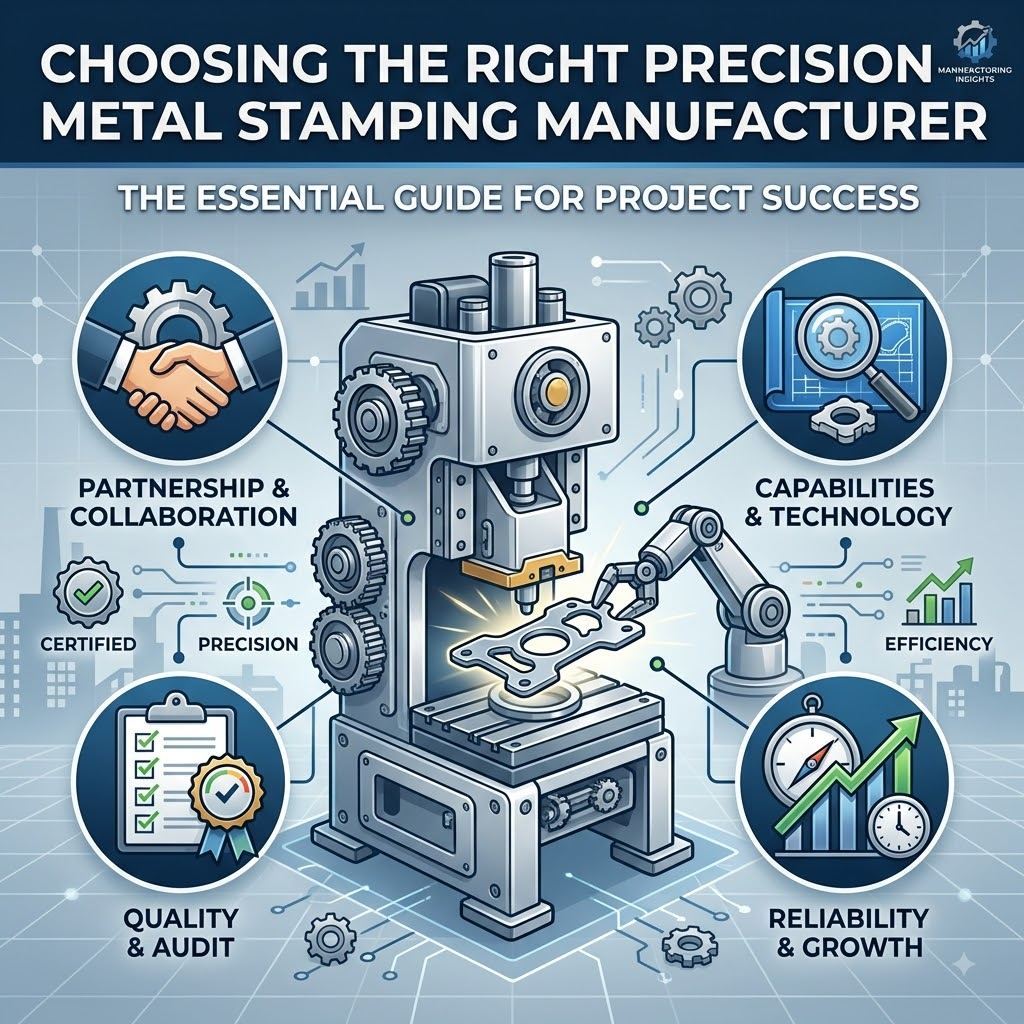
Conclusion: Choosing the Right Solution for Custom Metal Stamping Parts
Custom Metal Stamping Parts remain one of the most important manufacturing solutions for automotive and industrial applications because they combine precision, scalability, and production efficiency.
However, successful stamping projects require more than selecting a production supplier.
The most reliable results come from cooperation between:
· Product designers
· Engineering teams
· Material specialists
· Tooling engineers
· Manufacturing partners
From initial design analysis to final inspection, every stage influences the performance of the finished component.
For automotive manufacturers, industrial equipment companies, and engineering teams, understanding the complete stamping process helps make better decisions about cost, quality, and long-term supply reliability.
A good stamping partner does not simply produce metal parts.
They help transform engineering requirements into reliable, repeatable, and production-ready components.