Complex Geometry Precision Stamping Parts with Progressive Die Technology
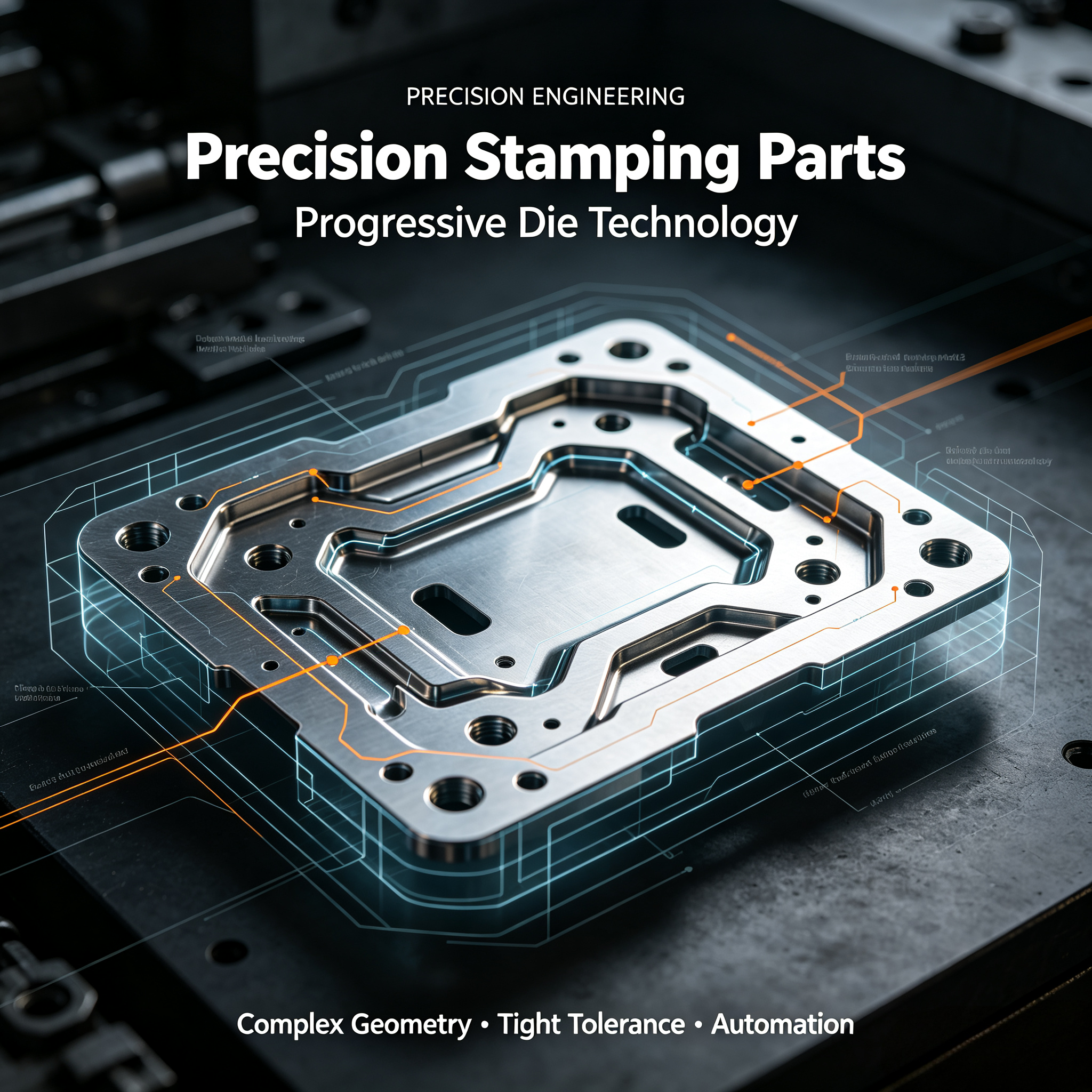
Table of Contents
1.Introduction
2.What Makes a Stamping Part "Complex"?
3.How Progressive Die Technology Works
4.The Engineering Challenge: Complex Geometry in a Single Pass
5.Key Technical Capabilities and Tolerances
6.Industries That Rely on Complex Precision Stamping Parts
7.Real-World Case Study: Automotive Seal Component
8.Technical Specifications at a Glance
9.The Future of Progressive Die Stamping
10.FAQ
11.Conclusion
1. Introduction
Let me start with something I've learned the hard way over the years. When a customer hands you a part print with multiple bends, tight radii, and features that seem to fight each other, the first instinct is often to say "this needs to be a transfer die" or "we'll have to do secondary operations."
But here's the thing. Progressive die technology has come a long way. What used to require multiple setups, separate tools, and hours of secondary machining can now be done in a single press — in one continuous strip of metal.
I've seen parts that I would have sworn couldn't be produced in a progressive die, run at speeds that would make your head spin. And the geometry? We're talking about parts with multiple bends in different directions, embosses, pierced holes at odd angles, and forms that require material to flow in ways that seem impossible.
The key is understanding what progressive die stamping can actually do today. Not what it could do ten years ago. What it can do now.
This article is for engineers, procurement folks, and anyone who's ever looked at a complex part and wondered: "Can this really be done in a progressive die?" I'm going to walk you through how it works, what's possible, and why precision stamping parts with complex geometries are more achievable than ever.
2. What Makes a Stamping Part "Complex"?
Before we go any further, let's be clear about what we mean by "complex geometry."
A simple stamping part might be a flat washer with a single hole. A complex part? That's a different story.
Complex geometry in precision stamping parts typically involves one or more of these characteristics:
Multiple bends in different planes — not just a simple 90° flange, but bends that go up, down, and sideways
Tight radii — bends that approach the material's minimum formable radius
Deep drawn features — forms that pull material significantly from the surrounding area
Precision cutouts at odd angles — holes and slots that aren't parallel to the strip feed direction
Embosses and coining — raised or recessed features that require material displacement
Asymmetrical shapes — parts that aren't mirror images, which make strip layout trickier
The challenge with complex geometry isn't just that it's hard to form. It's that each forming operation affects the material in ways that can compromise subsequent operations. Bend a part too early, and you might not be able to pierce a hole where you need it. Form too aggressively, and you might distort features that were already finished.
This is where progressive die stamping really earns its keep.
3. How Progressive Die Technology Works
Let me explain the basics for anyone who's new to this.
Progressive die stamping is an automated, high-precision manufacturing technique where a continuous metal strip feeds through multiple stations within a single die set. Each station performs a specific operation — punching, bending, forming, piercing, or cutting — in sequence. The strip advances incrementally with each press stroke, and by the time it reaches the final station, you have a finished part.
Here's what makes it powerful for complex geometry precision stamping parts: instead of doing one operation at a time across multiple machines and setups, everything happens in one continuous flow. The part never leaves the strip until it's fully formed.
Think of it like an assembly line, but for metal forming. Each station adds something. Each station refines the shape. And because the strip keeps the part positioned precisely throughout the process, you get exceptional consistency and repeatability.
Modern progressive dies can run at speeds exceeding 1,200 strokes per minute for simpler components, translating to tens of thousands of parts per hour. For complex parts, speeds are lower, but the throughput is still far beyond what any manual or single-stage process can achieve.
4. The Engineering Challenge: Complex Geometry in a Single Pass
Here's where things get interesting — and where a lot of people get it wrong.
The biggest misconception I hear is that progressive dies are only good for simple parts. That's simply not true anymore.
Advanced progressive die design has evolved to handle geometries that were previously considered impossible for this process. The introduction of multi-functional dies means that each station can now perform compound actions, not just single operations.
But designing a progressive die for a complex part requires a different mindset. You have to think about:
Strip layout. This is the roadmap for the entire process. It defines every operation, every station, and how the part moves through the tool. For complex geometries, the strip layout becomes a puzzle — how do you sequence operations so that each step enables the next, without creating conflicts?
Carrier design. The part needs to stay attached to the strip while it moves through the die. The carrier web has to be strong enough to transport the part through all stations, but weak enough to be easily separated at the end.
Material flow. When you bend or form metal, the material has to go somewhere. It stretches, compresses, and shifts. Understanding how the material will behave at each station is critical. This is where simulation software has become invaluable.
Springback compensation. Metal doesn't always stay where you put it. After forming, it springs back slightly. For complex geometries with multiple bends, springback can compound in unpredictable ways. Modern die design accounts for this through careful over-forming and coining operations.
The good news? Software tools have made this much more manageable. AutoForm ProgDie R13, for example, now allows designers to flexibly reorder geometric features like forms and holes directly within the strip layout, and provides more accurate press force evaluation by considering intermediate time steps. As Dr. Markus Thomma, CMO of the AutoForm Group, put it: "With AutoForm ProgDie R13, users have more flexibility in designing the progressive die stamping process and can gain deeper insights in order to quickly identify problems that might occur in practice".
5. Key Technical Capabilities and Tolerances
Let's get into the numbers, because this is what actually matters when you're specifying a part.
Precision stamping parts produced with progressive die technology can consistently hold tolerances as tight as ±0.002 inches (±0.05 mm). Some high-end operations can achieve even tighter — ±0.01mm positioning accuracy is possible with ultra-high precision setups.
Here's a quick reference for what's achievable:
Capability Typical Range
Dimensional tolerances ±0.05 mm (standard), ±0.01 mm (high precision)
Material thickness 0.1 mm to 6.0 mm
Production speed Up to 1,200+ strokes per minute
Material yield Often exceeding 95%
Tooling investment $50,000 to $500,000+ depending on complexity
The global market for Precision Progressive Dies was valued at approximately US$509 million in 2025** and is projected to reach **US$786 million by 2032, growing at a CAGR of 6.5%. This growth reflects the increasing demand for high-precision stamping parts across automotive, electronics, and other industries.
What does this mean for you? It means that if you're considering progressive die stamping for a complex part, you're not alone. The industry is moving in this direction because the economics work — high upfront tooling cost, but exceptionally low per-unit cost at volume.
6. Industries That Rely on Complex Precision Stamping Parts
Precision stamping parts with complex geometries are everywhere. You just don't always see them.
Automotive Industry
This is the largest application area. Complex geometry stamping parts are used for everything from safety-critical components to structural parts:
Airbag initiator housings and seat belt latch plates — these require absolute consistency because lives depend on them
Battery busbars for electric vehicles — produced with precise tolerances to handle high current
Engine and transmission components like clutch plates and brake system parts
Automotive seat side cushion panels — these can be highly asymmetrical and require deep drawing, making them challenging even for progressive dies
Electronics and Consumer Goods
The miniaturization trend in electronics is perfectly matched to progressive die stamping:
Semiconductor lead frames
Electrical connectors with intricate pin geometries
EMI/RFI shielding cans
Internal components for smartphones and laptops — hinge mechanisms, battery contacts
Aerospace and Defense
For applications requiring reliability in high-stress environments:
Electrical connectors for avionics
Shim plates
Brackets and retainers for control systems
Medical Device Manufacturing
The process is ideal for sterile, high-precision components:
Surgical stapler components
Tiny blades for dermatological tools
Implantable device housings
Guide tubes for laparoscopic surgery
7. Real-World Case Study: Automotive Seal Component
Let me share a real example that illustrates what's possible.
A customer in the automotive industry needed to produce a Metric Stat-O-Seal for use in an automotive application. The part was made from 4130 chrome molybdenum steel, meeting SAE AMS 6350/6351 standards.
Here's the challenge: the part had tight tolerances, complex geometry, and needed to withstand years of use on the road. The supplier designed the tooling to allow 3-up production — three parts per press stroke — which tripled productivity and improved material yield.
The progressive die stamping was performed on a 175-ton press with an automated production line. They achieved tolerances of ±0.002 inches.
But here's what really impressed me. Before production, first article samples underwent 72-hour salt spray corrosion testing in accordance with ASTM B117. The parts received extensive dimensional testing, zinc plating, and heat treatment to 120,000-136,000 psi (827-938 MPa).
All of this — from coil to finished, tested, plated part — was done in a single progressive die. That's the power of the technology when it's done right.
8. Technical Specifications at a Glance
Here's a quick reference table for progressive die capabilities versus single-stage alternatives:
Characteristic Single-Stage Die Progressive Die
Operations per stroke One Multiple in sequence
Production volume Low to medium High volume
Automation level Manual or semi-automatic Fully automated coil feeding
Tooling cost Lower upfront Higher upfront
Per-unit cost Higher Lower at scale
Cycle time 8-12 seconds per piece 1.5-3 seconds per piece
Tooling lead time 3-4 weeks 4-6 weeks
Material Type Typical Thickness Range Common Applications
Steel / Stainless Steel 0.1 - 6.0 mm Automotive structural parts, brackets
Aluminum 0.2 - 4.0 mm Lightweight components, electronics
Copper / Brass 0.1 - 3.0 mm Electrical connectors, terminals
Specialty alloys Varies Aerospace, medical devices
9. The Future of Progressive Die Stamping
I mentioned earlier that the industry is moving. Here's where it's going.
Simulation and digital twin technology is becoming standard. AutoForm ProgDie R13, released in late 2025, is a good example — it allows designers to work with self-symmetrical parts, create optimal strip layouts with minimal material consumption, and evaluate press forces with unprecedented accuracy.
Multi-functional dies are pushing the boundaries of what's possible in a single pass. Instead of one operation per station, each station can now perform compound actions.
Integration with automation means that progressive die stamping is increasingly part of broader automated production lines, with robots handling coil loading, part inspection, and downstream assembly.
The trend is clear: complex geometry precision stamping parts will become more achievable, more cost-effective, and more widely used across industries.
10. FAQ
Q: What's the minimum production volume that justifies a progressive die?
A: Typically, progressive die stamping becomes cost-effective above 50,000 parts per year. Below that, the tooling investment is hard to justify. But if you have a complex part with tight tolerances, even lower volumes might make sense because of the consistency and quality you get.
Q: Can progressive dies handle deep drawing?
A: Yes, but it's challenging. Deep drawing requires careful strip layout and material flow analysis. Unsymmetrical deep-drawn parts are particularly difficult because the material weight can affect positioning between stations. But with modern die design and simulation, it's increasingly achievable.
Q: How long does a progressive die last?
A: With proper maintenance, a well-built progressive die can produce millions of parts. Regular preventive maintenance — typically every 100,000 to 250,000 strokes — is essential to maintain quality and extend tool life.
Q: What's the biggest cost in progressive die stamping?
A: The initial tooling investment. Complex dies can cost $50,000 to $500,000+. But the per-unit cost drops dramatically at volume, making it highly economical for long production runs.
Q: Can progressive dies produce parts with different materials?
A: Yes. The process works across steel, stainless steel, aluminum, copper, brass, and specialty alloys. The die design and process parameters need to be adjusted for each material's specific forming characteristics.
11. Conclusion
Look, I'll be honest with you. Progressive die stamping isn't the right answer for every part. If you're making a few hundred pieces, it's probably overkill. If your geometry is simple and your tolerances are loose, there are cheaper options.
But if you need complex geometry precision stamping parts in high volumes? If you need consistency that manual processes can't match? If you want to eliminate secondary operations and reduce handling?
Progressive die technology is hard to beat.
The industry is investing in it. The market is growing at over 6% annually. Software tools are making complex die design more accessible than ever. And the range of parts that can be produced in a progressive die is expanding every year.
The next time someone tells you a part can't be done in a progressive die, ask them when they last looked at the technology. The answer might surprise you.