Choosing the Right Precision Metal Stamping Manufacturer for Your Project
You know what's interesting? I've been in and around the manufacturing world long enough to see the same mistake play out over and over again. A company needs metal stamped parts. They find a supplier. They get a quote. They place an order. And then—six months later—they're dealing with quality issues, delivery delays, or tooling that didn't quite work the way it was supposed to.
The problem isn't usually the supplier's capability. It's that the buyer didn't know what questions to ask upfront.
I've sat in enough meetings with procurement teams and engineers to know that precision metal stamping can feel like a black box if you haven't been through it before. And honestly? Even if you have, the industry changes fast enough that what worked five years ago might not be the right approach today.
This guide is my attempt to demystify the process. Whether you're sourcing components for automotive assemblies, medical devices, electronics, or industrial equipment, I want to walk through what actually matters when choosing a precision metal stamping manufacturer—and how to avoid the costly surprises I see far too often.
Table of Contents
1. Why Precision Metal Stamping Matters in Modern Manufacturing
2. Understanding Precision Tolerances: What "Precision" Actually Means
3. Progressive Die vs. Transfer Die Stamping: Which Process Fits Your Part?
4. Material Selection for Precision Stamped Components
5. Design for Manufacturability: Getting It Right Before Tooling Starts
6. Tooling Costs and What Drives Them
7. What to Look for in a Precision Metal Stamping Partner
8. Real-World Application Examples
9. Frequently Asked Questions
10. Conclusion
Why Precision Metal Stamping Matters in Modern Manufacturing
Let's start with the big picture.
The global metal stamping market was valued at roughly USD 257 billion in 2025 and is projected to reach USD 374 billion by 2033, growing at a compound annual rate of about 5%. That's a massive industry, and the precision segment is growing even faster—some estimates place the precision metal stamping services market at USD 263 million in 2025, with projections reaching USD 453 million by 2032.
What's driving all this growth? Three things, mainly.
First, electric vehicles. EVs require significantly more stamped components than internal combustion vehicles—battery housings, motor laminations, busbars, terminals, cooling brackets. One industry analyst noted that "EV transition acts as the primary growth driver" for precision stamping. And it's not just automotive. Consumer electronics is expected to grow at over 6% annually through 2033 as devices get smaller and more sophisticated. Medical devices are pushing the envelope too, with components getting smaller and tolerances getting tighter.
Second, the push for lightweighting. Automakers and aerospace companies are adopting high-strength steels, aluminum alloys, and advanced materials that require more sophisticated stamping processes. These materials don't behave the same way as mild steel—they spring back more, they wear dies faster, and they demand tighter process control.
Third, automation and smart manufacturing. Servo-driven presses, in-die sensors, and real-time quality monitoring are becoming standard in competitive stamping operations. Some advanced stamping lines now run at 1,600 strokes per minute with integrated vision inspection.
The bottom line? Precision metal stamping isn't going anywhere. But the bar for what counts as "precision" keeps getting higher.
Understanding Precision Tolerances: What "Precision" Actually Means
Here's something I see a lot: buyers ask for "precision" stamping without really understanding what that means in practical terms.
Precision metal stamping typically holds tolerances tighter than standard commercial stamping. Standard stamping might hold ±0.1 mm to ±0.25 mm. Precision stamping, by contrast, often works within ±0.01 mm to ±0.05 mm. For ultra-precision applications—think high-end electronics or medical devices—tolerances can go down to ±0.005 mm.
To put that in perspective: a human hair is about 50 microns (0.05 mm) thick. So when a manufacturer says they can hold ±0.01 mm, they're talking about accuracy that's five times thinner than a human hair.
But here's the thing. Not every part needs that level of precision. And specifying tighter tolerances than necessary drives up cost—sometimes significantly. A die that needs to hold ±0.01 mm tolerances can cost 30% to 50% more than standard ±0.05 mm tooling.
The key question isn't "how precise can you make this?" It's "how precise does this part actually need to be to function correctly?" A mounting bracket might not need micron-level accuracy. A connector terminal in a medical device absolutely does.
What affects achievable tolerances?
·
Material thickness: Thinner materials generally allow tighter tolerances. Standard precision stamping typically works with 0.1 mm to 3.0 mm thickness, with most applications falling between 0.3 mm and 1.2 mm.
Material type: Soft, ductile materials like copper and aluminum can be stamped to tighter tolerances than high-strength steels.
Part geometry: Simple shapes are easier to hold tight tolerances on than complex forms with multiple bends and features.
Die quality: A well-maintained, precision-ground die will hold tolerances longer and more consistently.
I always tell people: be realistic about what you need, and don't pay for precision you don't actually require. But also—don't underestimate what a good precision metal stamping manufacturer can achieve if you give them the right design and the right material.
Progressive Die vs. Transfer Die Stamping: Which Process Fits Your Part?
This is one of the most common questions I get, and honestly, there's no single right answer. It depends on your part, your volume, and your budget.
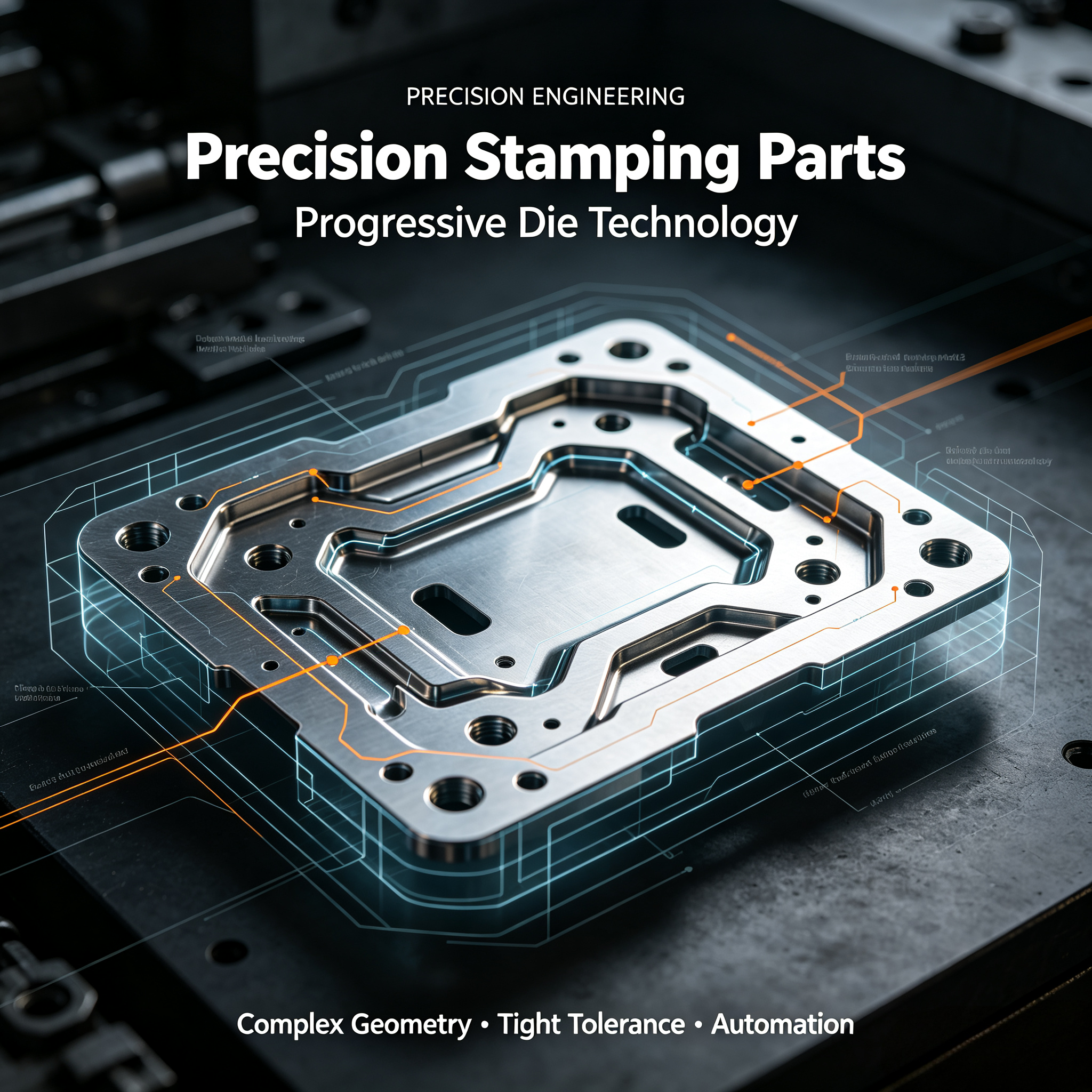
Progressive die stamping is what most people think of when they imagine high-volume metal stamping. A coil of metal is fed through a die with multiple stations. Each station performs an operation—piercing, forming, bending, blanking—until the finished part drops out at the end. The metal strip itself acts as the carrier that moves the part through the die.
Transfer die stamping works differently. The blank is cut from the strip first, then mechanical fingers or robots physically move the individual part from station to station. The part isn't attached to a carrier strip, which gives more flexibility for complex geometries.
Here's how they compare in practice:
Parameter | Progressive Die | Transfer Die |
Part complexity | Low to medium (2D/shallow 3D) | High (deep draw, multi-axis form) |
Material scrap | ~15–25% (carrier strip required) | ≤8% (near-net scrap) |
Cycle speed | 60–400 strokes per minute | 12–60 strokes per minute |
Tooling cost (China, 2026) | USD $15,000–$80,000 | USD $60,000–$250,000+ |
Ideal batch size | ≥ 500,000 pieces per year | 50,000–500,000 pieces per year |
Part size range | Up to ~300 mm strip width | Up to 800 mm+ individual blanks |
So which one should you choose?
Progressive stamping is usually the better choice for high-volume, smaller parts where speed and automation are priorities. It's faster, more automated, and generally more cost-effective at very high volumes. One automotive supplier I worked with switched from a 4-station transfer die to a 10-station progressive die and saw per-piece cost drop by 22%, with throughput increasing from 180 to 310 parts per hour.
Transfer stamping makes more sense for larger parts, more complex geometries, or lower production runs. It offers more flexibility in how the part is manipulated, and because there's no carrier strip, material utilization is better.
One thing to keep in mind: progressive dies are complex to develop and require precise piloting to ensure the metal is fed accurately to each station. But once they're running, they're incredibly efficient. Transfer dies have higher upfront tooling costs but can handle parts that simply can't be made in a progressive die.
Material Selection for Precision Stamped Components
The material you choose has a huge impact on what's possible with precision metal stamping—and what it's going to cost.
Stainless steel is probably the most common material for precision stamping. Grades like 304 and 316L offer excellent strength and corrosion resistance. It's used extensively in medical devices, automotive components, and industrial applications where durability matters. The trade-off? Stainless steel work-hardens during stamping, which means dies wear faster and forming is more challenging.
Aluminum (grades like 5052 and 6061) is popular for lightweight applications. It's easier to form than steel, doesn't work-harden as aggressively, and offers good corrosion resistance. EV battery components, electronics enclosures, and aerospace parts often use aluminum stampings. The downside is lower strength compared to steel.
Copper and brass are the go-to materials for electrical and thermal conductivity applications. Copper busbars, terminals, and connectors are all common precision stamped components. Copper is highly ductile—you can stamp it to extremely tight tolerances, down to 0.01 mm thickness in some cases. But it's expensive and can be challenging to handle in high-speed presses.
Other materials you might encounter include:
Titanium: Used in medical implants and aerospace, but difficult to stamp
High-strength low-alloy (HSLA) steel: Increasingly common in automotive for lightweighting
Precious metals: Gold, silver, and their alloys for high-reliability electrical contacts
The thickness range for precision stamping typically falls between 0.1 mm and 3.0 mm, with most applications in the 0.3 mm to 1.2 mm range. For ultra-thin applications—microelectronics, medical shims, EMI shielding—you can go down to 0.01 mm, but that requires ultra-precision dies and specialized equipment.
One thing to watch: material costs are volatile. Steel, stainless steel, and aluminum prices fluctuate, and that affects stamping costs directly. A good precision metal stamping manufacturer should be transparent about material sourcing and offer long-term contracts or hedging options if you're planning a high-volume program.
Design for Manufacturability: Getting It Right Before Tooling Starts
I can't emphasize this enough: the time to think about manufacturability is before the die is designed, not after.
Design for Manufacturability (DFM) is the process of optimizing a part design so it can be manufactured efficiently, consistently, and cost-effectively. In precision metal stamping, DFM is absolutely critical because once the die is cut, changes are expensive and time-consuming.
Key DFM principles for precision stamping:
Bend radii: The minimum inside bend radius should generally be at least equal to or greater than the material thickness. For most metals, 1.5 times material thickness is a safer starting point.
Hole placement: Hole diameter should be larger than the material thickness to prevent punch breakage. Holes should be located at least 1.5 times the material thickness away from a bend.
Formed leg length: The length of a formed leg should be a minimum of 2.5 times the material thickness.
Grain direction: Specify grain direction early in the design process. Stamping across the grain versus with the grain affects formability and springback.
Feature count: Combine features where possible and standardize dimensions. Avoid details that would require extra operations unless they're essential to part functionality.
I've seen companies save 40% on tooling costs just by making small design changes before the die was built. The best precision metal stamping manufacturers will offer DFM feedback early in the process—they'll look at your drawings, identify potential issues, and suggest modifications that improve manufacturability without compromising function.
Here's a practical example: One automotive supplier needed a steel mounting bracket—2.0 mm thick, 6 holes, 3 bends—at 150,000 units per month. The manufacturer built a 14-station progressive die to handle it. But that wasn't the first design. They went through several DFM iterations to optimize the strip layout, reduce scrap, and ensure consistent forming.
The lesson? Involve your stamping partner early. Don't wait until the design is finalized and then ask them to make it work.
Tooling Costs and What Drives Them
Tooling is usually the single biggest upfront cost in a precision metal stamping project. And it's also the most misunderstood part of the quote.
What drives tooling costs?
Part complexity and number of stations: The more complex your part geometry, the more stations the die requires. Each station adds cost—more machining, more components, more assembly time.
Tolerances and precision requirements: Tighter tolerances mean more calibration hours, more precise machining, and higher-quality materials in the die itself. A die that needs to hold ±0.01 mm tolerances can cost 30% to 50% more than standard ±0.05 mm tooling.
Expected tool life and production volume: A die designed for 10 million hits needs higher-quality steel, better heat treatment, and more robust design than a die for 100,000 hits.
Number of cavities: Adding multi-cavity tooling increases upfront expense by about 20% to 40% but reduces per-part cost at higher volumes.
Material type: Stamping high-strength steel or stainless steel wears dies faster and may require more expensive die materials (carbide inserts, for example).
Here's the thing about tooling costs that a lot of buyers miss: the quoted tooling cost isn't always the full picture.
Some suppliers quote tooling as a lump sum due before production. Others amortize it across your first order, hiding it in the per-part price. Some bury it entirely and recover it through higher piece prices over time.
Questions you should ask about tooling:
Who owns the die after it's built?
What's the expected tool life, and what happens when it needs maintenance or replacement?
Are tryout and adjustment included in the quoted tooling cost?
Who pays for ongoing die maintenance?
A transparent precision metal stamping manufacturer should answer these questions clearly. If they can't or won't, that's a red flag.
What to Look for in a Precision Metal Stamping Partner
Choosing the right manufacturer goes beyond comparing quotes. I've seen buyers go with the lowest bid and end up paying far more in the long run—through quality issues, delivery delays, and rework.
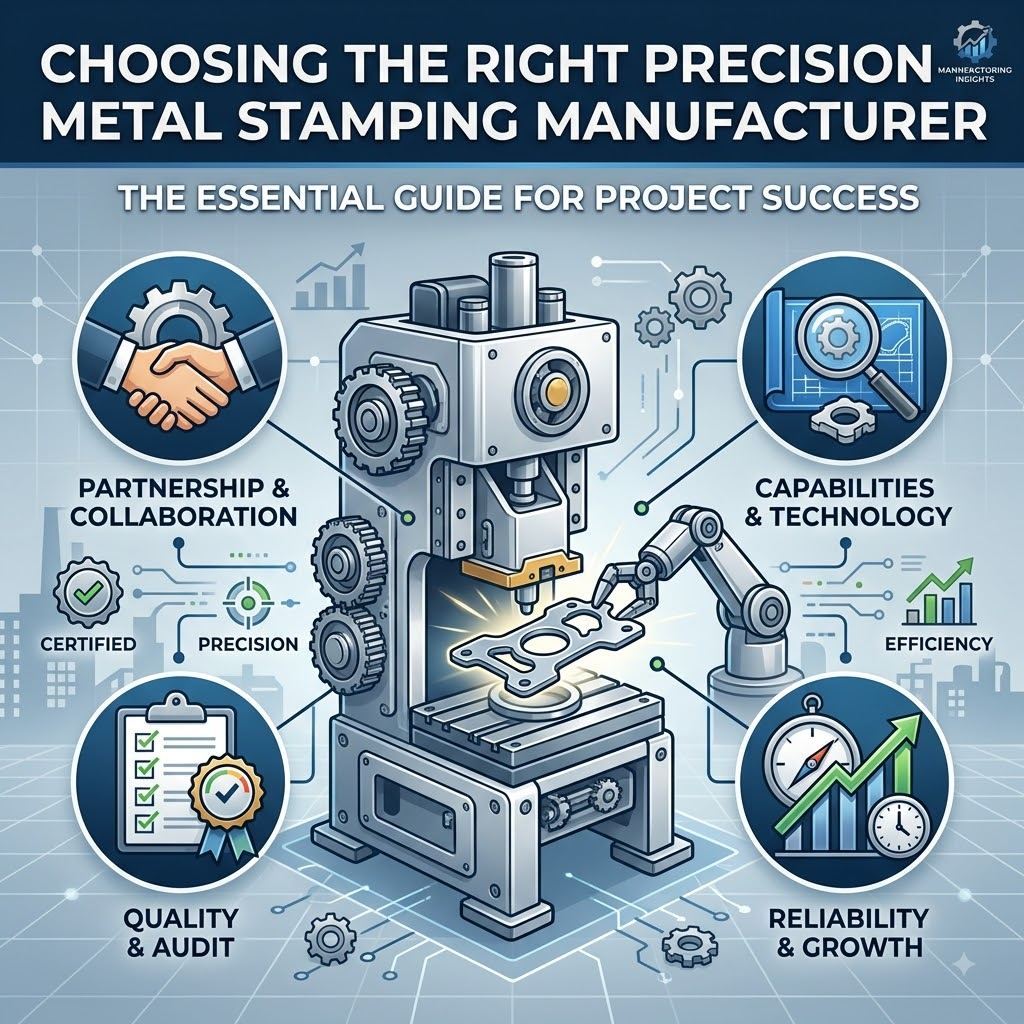
Here's what I recommend evaluating:
Technical capabilities: Press tonnage range, material thickness capabilities, and part size capacity all determine whether a supplier can meet your production requirements. A manufacturer with a diverse range of press sizes can handle everything from lightweight, intricate parts to larger, more robust components.
In-house tooling: Look for vendors with in-house tooling and die-making facilities. This reduces dependency on third parties and accelerates prototyping. It also means they understand the tooling intimately when issues arise during production.
Quality certifications: In regulated industries, certifications like ISO 9001:2015 and IATF 16949 (automotive) or ISO 13485 (medical) signal that a manufacturer operates with consistent quality controls. Medical device stamping, in particular, requires ISO 13485 as a minimum. For automotive, IATF 16949 certification indicates the supplier understands the rigorous quality requirements of the industry.
Engineering support and DFM: A capable manufacturer should act as an engineering partner, not just a production vendor. Early-stage collaboration through DFM can identify opportunities to reduce scrap, streamline tooling, and improve product performance before production begins.
On-time delivery performance: Aim for suppliers with on-time delivery rates of 98% or higher. Response time under 3 hours and reorder rates above 35% are also good indicators of consistent customer satisfaction.
Secondary operations: Today's best suppliers offer end-to-end services—from initial design support to final assembly, with secondary operations like anodizing, plating, welding, and assembly. This reduces the number of vendors you need to manage.
Supply chain resilience: International buyers are increasingly focused on supply chain resilience, stable lead times, and full-process manufacturing capability under one roof.
One practical tip: Ask for references from companies in your industry. A supplier that does great work for consumer electronics might not have the quality systems in place for medical devices. Industry-specific experience matters.
Real-World Application Examples
Automotive: EV Battery Busbars
Precision metal stamping is playing a critical role in the electric vehicle transition. Busbars—flat conductive strips that connect battery cells—are typically stamped from copper or aluminum and require extreme flatness to prevent energy loss.
One automotive supplier I know of was producing EV battery busbars with flatness held to ±0.1 mm, using progressive stamping dies with carbide inserts to ensure consistency across high volumes. The challenge? Copper work-hardens during stamping, and maintaining dimensional stability across millions of parts requires precise process control.
Medical: Surgical Instrument Components
Medical devices demand biocompatibility, sterilizability, and sub-millimeter accuracy. One startup medical device company significantly reduced costs by converting a fully machined part to a stamped part with machined features.
Stainless steel shafts for laparoscopic tools are stamped with micro-serrated edges at tolerances of ±0.01 mm. The key requirement here is eliminating burrs—any sharp edge or irregularity could compromise sterility or damage tissue.
Electronics: EMI Shielding and Connectors
Consumer electronics is driving demand for micro-precision stamped components. SIM trays, battery contacts, and shielding cans often require tolerances of ±0.005 mm.
One manufacturer I spoke with produces EMI shields for mobile devices—stamped from thin-gauge stainless steel or copper alloy, with complex geometries to fit specific board layouts. The challenge isn't just the tolerance; it's maintaining that tolerance across millions of parts in high-speed progressive dies running at 1,000+ strokes per minute.
Frequently Asked Questions
What's the difference between precision metal stamping and standard stamping?
Precision stamping typically holds tighter tolerances (±0.01 mm to ±0.05 mm) compared to standard stamping (±0.1 mm to ±0.25 mm). It also involves more sophisticated tooling, tighter process controls, and often higher-speed equipment.
What industries use precision metal stamping?
Automotive (particularly EVs), medical devices, aerospace, electronics, telecommunications, and industrial equipment are the primary users.
How much does precision metal stamping tooling cost?
It varies widely based on part complexity, tolerances, and production volume. Progressive dies typically range from USD 15,000 to 80,000, while transfer dies can cost USD 60,000 to 250,000 or more.
What's the minimum thickness for precision stamping?
For ultra-thin foils, you can go down to 0.01 mm (10 microns) with soft, ductile materials like copper or aluminum. Standard precision stamping typically works with 0.1 mm to 3.0 mm.
How do I choose between progressive and transfer die stamping?
Progressive stamping is generally better for high-volume, smaller parts where speed is critical. Transfer stamping offers more flexibility for larger, more complex parts or lower production volumes.
What certifications should a precision metal stamping manufacturer have?
At minimum, ISO 9001. For automotive, IATF 16949. For medical devices, ISO 13485.
Conclusion
Choosing the right precision metal stamping manufacturer isn't just about finding the lowest quote. It's about finding a partner who understands your application, can offer DFM feedback early in the process, has the right equipment and certifications for your industry, and is transparent about tooling costs and lead times.
The market is growing—driven by EVs, medical device miniaturization, and consumer electronics. And the bar for precision keeps getting higher. Some production lines now run at 1,600 strokes per minute with online vision inspection. Tolerances that were considered "precision" a decade ago are now standard.
If you're sourcing stamped components, here's my advice: start with your requirements. Be realistic about tolerances—don't specify tighter than you need. Involve your stamping partner early in the design process. Ask the right questions about tooling ownership, die maintenance, and quality systems. And don't be afraid to push back if something doesn't add up.
A good precision metal stamping manufacturer will welcome those questions. They'll walk you through the trade-offs between cost and capability. They'll help you optimize your design for manufacturability. And they'll deliver parts that meet your specifications—consistently, on time, and on budget.
Because in the end, that's what precision manufacturing is really about: getting it right, every single time.